
Lion’s Roar Day One: Israel–US Strikes, Iran’s Leadership Shock, and What Comes Next
A balanced recap of the opening 24 hours—remarkable intelligence, a muted but real Iranian response, global economic fallout, and no clear end in sight

Day one of Operation Lion’s Roar has achieved two things simultaneously. It has caused significant damage to the Iranian state’s senior leadership and command structure, and it has also reminded us that conflicts in the Middle East do not remain localised for even a news cycle.
The basic outline is now clear. The Israeli account is unusually explicit about intent and method: an operational plan developed over months, centred around an intelligence effort led by the Intelligence Directorate to identify the precise moment when senior regime officials would convene, followed by hitting multiple gathering sites in Tehran simultaneously. Israeli targeting then switched to striking Iran’s missile and air defence capability (200 fighter jets simultaneously attacking 500 targets in Western and Central Iran - see images below), whilst the US prosecuted IRGC targets.
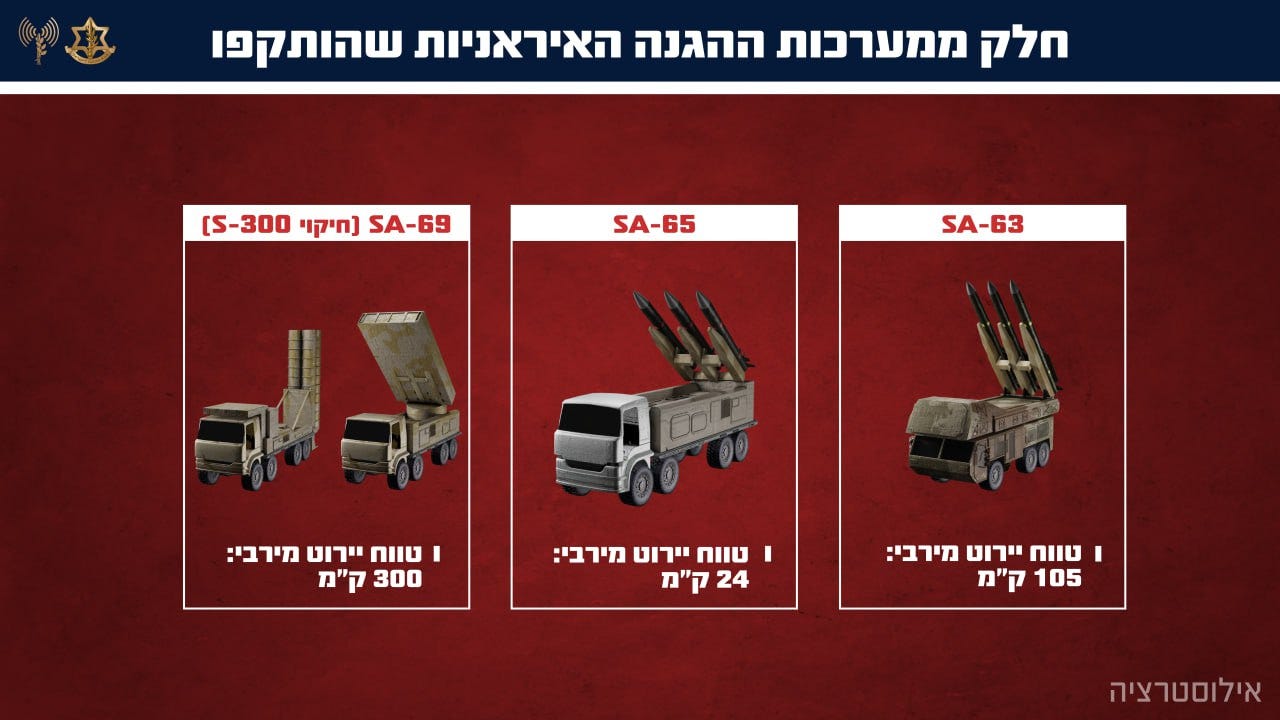
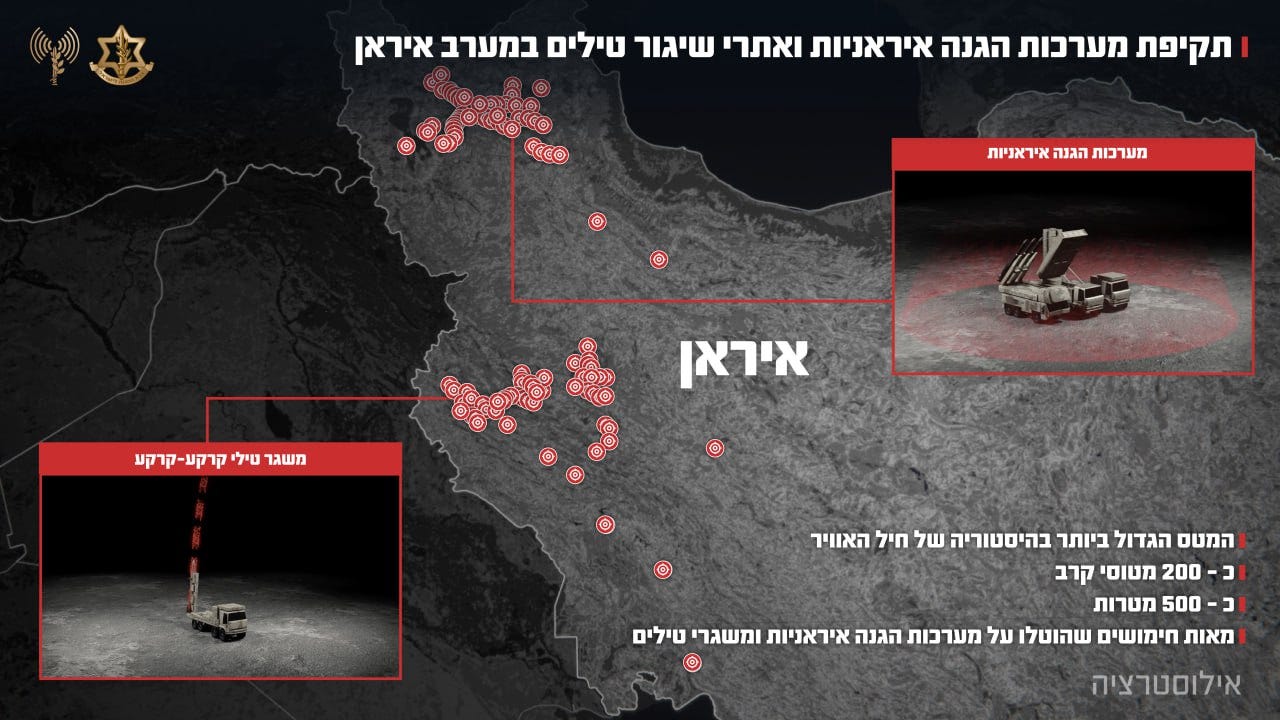
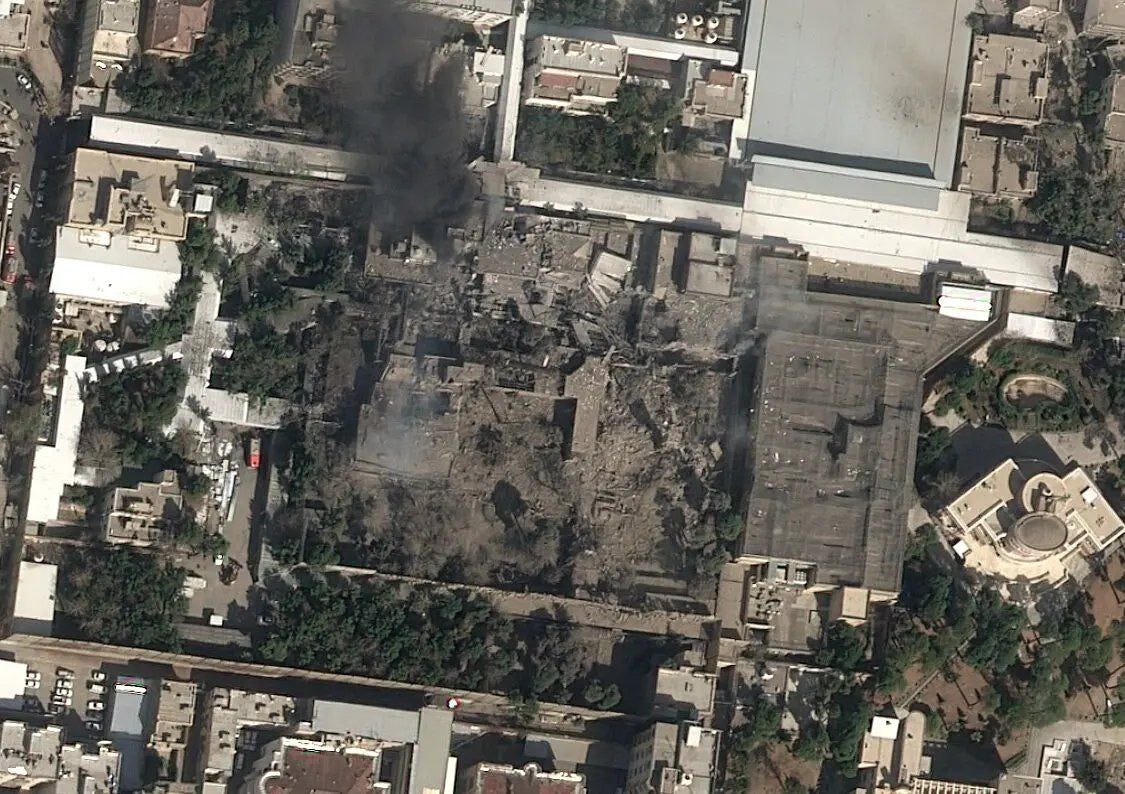
This choreography is the striking feature of day one, rather than the tonnage dropped. This was the kind of attack that depends on timing, pattern-of-life analysis, and precision location tracking; less “shock and awe,” more scalpel aimed at the nervous system. Israel is claiming it struck several sites where the political-security echelon had gathered, choosing morning over night, and achieving tactical surprise despite Iranian preparedness. That is, at minimum, a serious intelligence and operational achievement.
The reported results align with the targeting logic. It is widely reported through sources familiar with Israeli operations and a regional source that Iran’s Defence Minister, Amir Nasirzadeh, and the commander of the Islamic Revolutionary Guard Corps, Mohammad Pakpour, are believed to have been killed. Those are key managerial figures in the Iranian system. If they are gone, the regime has lost individuals who translate political intent into military action.
Regarding Khamenei, we must exercise caution because the information environment is already contaminated. He is clearly a target. Whether he is dead remains unconfirmed publicly. Earlier reports indicated he had been moved to a secure location, while other reports suggest the situation is still unclear. Earlier today, Channel 12 suggested that Israel considers his chances of survival as “slim to non-existent”, and as I type, they have published an Israeli government claim that his body has been found. However, remember that information is a weapon. Channel 12 is closely aligned with the Israeli government. It would greatly aid regime change ambitions based on a popular uprising if the Iranian people believe he is dead. Either way, if he is dead or incapacitated, the succession struggle now becomes the most critical second front of the war.
Iran’s response on day one has been weaker than many expected in scale and effect, but it has not been non-existent. Tehran has fired missiles and drones, managing to hit targets across the Middle East, including US regional bases and allies, reportedly Bahrain, Dubai (see video below), Saudi Arabia, Kuwait and Qatar. It is clearly an aim for Iran to strike Gulf neighbours in hopes that they will pressure the US to end the war swiftly (more on that aim in a moment).
A broader, uncomfortable lesson emerges for everyone observing the air defence situation. It is concerning that Iran has scored successful strikes around the Gulf on targets that have had weeks to prepare their defences. Even well-equipped defence networks have vulnerabilities when faced with high volume, complexity, geography, and limited reaction time. The drone issue, in particular, is no longer hypothetical. Low-cost systems, deployed across various areas and used to test for weaknesses, are pushing even the most capable militaries into a constant race for awareness and interceptor resources. If today is any indication, then we are not as prepared as we believe.
The economic shock arrived instantly, which is how you know this is not a contained event. Middle Eastern airspace closures triggered cascading disruption, and Dubai, one of the key nodes of global travel, was shut down, with mass flight cancellations and suspensions across major carriers. This war will impose a global tax: supply chains, business travel, cargo routing, insurance costs, and time.
Oil, too, is already pricing in a different world. The oil market reaction is less about what has been physically destroyed (as far as we know, that remains uncertain), and more about risk to flows and the credibility of threats to chokepoints. When the markets open, this will be the biggest market shock in decades, driven by fears about tanker traffic and Gulf exports. Separate reports indicate vessels have been receiving warnings from the IRGC that “no ship is allowed to pass” the Strait of Hormuz, one of the most crucial sentences you can broadcast into the global economy, whether or not it becomes fully enforceable in practice.
So yes: this war will prove phenomenally expensive globally. You can see it in oil, in aviation, and in the way global risk is being reassessed in real time. You will feel this war in your wallets (and Americans will feel it in their taxes).
There are also serious ethical and legal questions raised here. This is not the time for moral theatre, but it is important to be honest about the trade-offs involved. Under international law, the justification for using force will be debated endlessly: self-defence, immediacy, proportionality, and sovereignty. Most of the world will not share Washington’s or Jerusalem’s assumptions. Domestically in the United States, the issue of authorisation is also significant: major hostilities launched without explicit congressional approval are always politically and constitutionally damaging, especially if the conflict drags on. We can hold two ideas at once: the Iranian regime is a violent actor deserving of what comes their way, and the manner in which this has been handled is yet another Trump-shaped nail in the coffin of the rules-based framework that the West once claimed to uphold.
Strategically, the region has already been reshaped. An external power cannot attempt a leadership decapitation strike on a major regional power and then simply revert to normal. Whether it is a ceasefire, escalation, or a prolonged attritional conflict, whatever unfolds next will happen in the shadow of a precedent that has now been set.
However, it is crucial not to mistake day one’s overwhelming tactical success for the final strategic outcome. This struggle is far from over, and the most difficult phase is still to come because the political challenge far surpasses the military one. If Khamenei disappears, the internal contest for succession begins amid bombardment and humiliation. Such an environment often favours the most ruthless rather than the most cautious. The CIA assessment ahead of this operation was clear: if Khamenei were killed, the likely successors might be hardline IRGC figures rather than moderates inclined to compromise.
Simultaneously, there is an alternative route that should not be overlooked. A successor, particularly one aiming to stabilise the system and halt the crisis, might conclude that survival is best secured through a deal. Khamenei’s successor could push for a return to negotiations and offer Trump the kind of agreement he desires: limits, verification, face-saving language, and a narrative of victory. We know from Venezuela that such an outcome is more than acceptable to Trump. The US cannot conquer Iran. Israel cannot conquer Iran. This means that the regime’s fundamental victory condition is straightforward: to survive in any form.
One risk, and I believe it is the main operational risk, is that the Iranian regime manages to prolong this conflict by outlasting falling bombs. The regime will look for vulnerabilities in the Gulf defence system, American bases, Israeli resilience, and the global economy. It will attempt to turn a conflict between states into something broader and more ideological; something that can be promoted, recruited around, and exported to Western streets in the way that Gaza was. They will try to transform tactical disadvantages into strategic advantage.
As I mentioned earlier today, the primary challenges now are time and ammunition supplies. Interceptors are limited, and so are precision munitions. Political patience also has its limits, and elements of Trump’s MAGA constituency have reacted extremely poorly to the war. The US does not conduct military operations in a vacuum; it depends on stockpiles, commitments, and industrial capacity that become crucial once a short-term shock shifts into an extended campaign.
This reminds me of a historical point worth keeping in mind tonight, especially since so much commentary is already slipping into “regime change by airstrike” fantasies.
Kosovo’s air campaign lasted 78 days. Even there, against a much smaller target set, with much more permissive geography, and with a limited political aim, the campaign only concluded once there was a credible sense that NATO might escalate towards a ground invasion. There is a genuine debate about how decisive that threat was compared to other pressures, but the point remains: air power did not deliver swift political surrender on a convenient timetable.
Libya lasted about seven months. The operation lasted 222 days from beginning to end, and Libya did not “work” because air power magically creates a new government. It worked (with that word doing heavy lifting, because the aftermath was an unfettered catastrophe) because there were organised rebels on the ground, and because external actors provided advisers, special forces and intelligence support that helped those rebels become militarily effective over time.
Unless something unexpected occurs, do not anticipate strikes on Iran leading to a quick regime change. Iran is geographically much larger, institutionally far stronger, and significantly more capable of enduring punishment while maintaining its coercive power. It also has a much larger and denser security apparatus than Libya’s. Furthermore, there is no credible threat of a ground invasion like in Kosovo, nor is there a unified, externally supported rebel force ready to seize and hold the state, as the Libyan rebels did once momentum shifted.
So where does that leave us at the end of day one?
It leaves us with an Iranian leadership structure that has been struck hard, perhaps catastrophically at the top, but with a state that still retains options and incentives to continue the fight. It leaves us with a region already suffering the consequences of airspace disruption and energy risks, and with the central strategic truth of this campaign: decapitation is easier than replacement. You can dismantle a system quickly, but building or even guiding what comes next is the more challenging task, and it is where wars either end or spread further.
This conflict still has a long way to go.
Today is the last day of my February Sale: sign up today for 20% off a whole year of analysis you will not find anywhere else: subscribe here!