When does a regime collapse?
Key events to look for in Iran
With protests in Iran hitting the headlines, here is a quick recap of a piece from the 12 Day War. Here are some of the factors to look for when it comes to regime collapse and change.
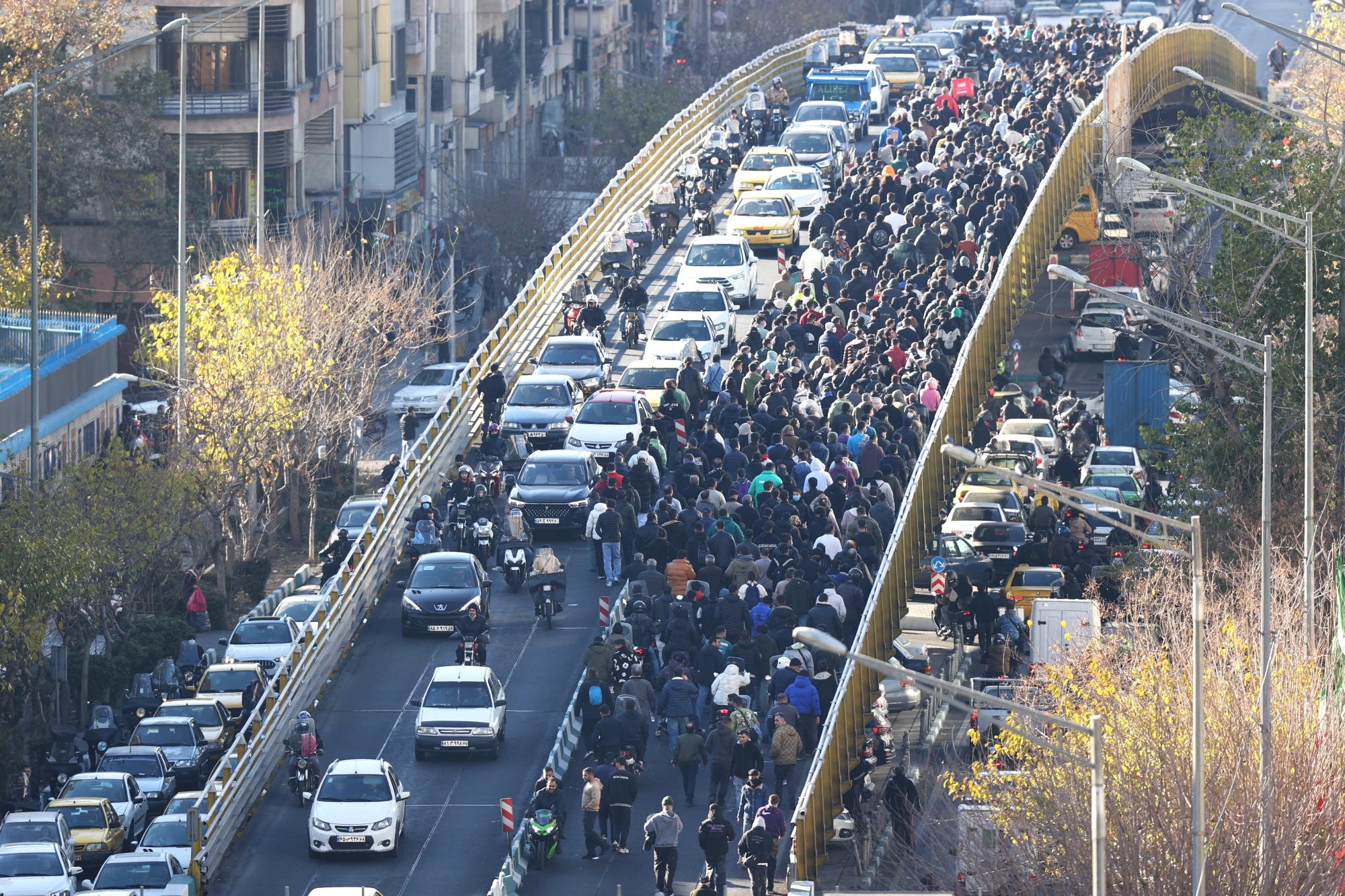
Military pressure alone, irrespective of its intensity, does not automatically lead to regime collapse. The breaking point of the Iranian regime will depend on a convergence of social, military, and psychological triggers that ultimately tip the balance. Drawing from historical precedents and Iran’s unique context, we can split this into social, military, and psychological thresholds that must be met.
Mass civil unrest (social threshold). Widespread, sustained protests and chaos in the streets could signal that the regime’s authority is irreparably eroded. Iran has witnessed waves of mass protests before, but the difference now lies in the regime’s weakened coercive power. If news of the leadership’s flight emerges, ordinary Iranians may lose their fear and surge into the streets in vast numbers, sensing that the regime is on its last legs. A general strike, protesters overrunning government buildings, or large crowds gathering in Tehran’s Azadi Square to celebrate an anticipated “liberation” would exert enormous pressure on what remains of the security forces. Unlike past uprisings, protesters would now carry the morale boost of having seen the once-mighty IRGC humbled by Israeli strikes. Exiled opposition figures are openly encouraging civil resistance. Reza Pahlavi, the ex-crown prince, urged Iranians and even security personnel to seize this moment, declaring, “The regime is weak and divided… Iran is yours to reclaim”. If the populace answers that call en masse, sheer people power could overwhelm the regime’s remaining loyalists.
Fracturing of Security Forces (military threshold). The Iranian regime’s survival has long hinged on the loyalty of its armed organs, such as the IRGC, the Basij militia, and the regular army. A collapse becomes likely if these forces fracture or stand down. We may see signs like mid-level commanders refusing orders to fire on crowds, garrisons surrendering or deserting, or even firefights between factions (e.g. IRGC hardliners vs Army units) as the chain of command breaks down. The decapitation strikes that killed or incapacitated many top generals and IRGC commanders are crucial here. They removed a vital component of the regime’s stability, potentially throwing the security establishment into confusion and leaderless disarray. With communications disrupted and commanders dead, frontline units might act on their instincts. The military rank-and-file, who are themselves Iranians with families suffering under the regime, could decide not to die for a lost cause. Even pockets of the IRGC, especially those deployed outside their home regions, might choose to abandon posts or negotiate with local communities. A pivotal moment would be if a major military unit or division openly switches sides to support the people, as happened in some instances of the 1979 revolution. Once security forces cease to function as a united repressive tool, the regime’s physical power collapses.
Psychological shock at the top (psychological threshold). Authoritarian regimes often project an aura of invincibility. Shattering that illusion can trigger a rapid unravelling. In Iran’s case, the sight (or rumour) of Supreme Leader Ayatollah Khamenei and his inner circle fleeing by plane to a foreign haven could be that shock. If the Supreme Leader is perceived to have given up or gone into hiding, it is game over for regime cohesion. Mid-level officials and clerics would begin defecting or disappearing, anticipating the regime’s fall. The remaining loyalists might resort to desperate, vicious measures, but their morale would be in free fall. Each additional blow, be it the fall of a major city to protesters or a live broadcast of a prominent ayatollah or Revolutionary Guard general announcing his resignation, would reinforce the collective sense that “this is the end.” We saw similar dynamics in other collapses: once fear shifts sides, the regime that once terrified everyone suddenly finds itself the one frightened of its people. As we saw last year in Syria, psychological tipping points can be abrupt. One day, a dictatorship seems securely entrenched; the next day it is melting away like ice in the sun.
Other factors could also accelerate the collapse. Information and communication will play a significant role. The regime has attempted to shut down the internet to prevent coordination, but reports suggest systems like Starlink are circumventing the blackout. This means that news of regime weakness and battlefield defeats spreads quickly, fueling the cycle of discontent. Meanwhile, economic paralysis (with banks closed and markets in a state of panic) and the breakdown of basic services (power outages resulting from strikes on infrastructure) contribute to a sense of impending chaos, convincing many Iranians that change is both inevitable and urgent.
Taken together, these social, military, and psychological triggers feed off one another. We may not pinpoint the exact moment of no return until we have the benefit of hindsight, but it could arrive soon. Perhaps it will be when a protester’s video goes viral, showing IRGC troops laying down their arms and joining the crowd, or when Friday prayers in a major city evolve into open defiance of the mullahs. When that moment arrives, the Islamic Republic’s 46-year reign could unravel with astonishing speed, ending not with a negotiated handover but with a sudden vacuum at the centre of power.


Thank you Andrew, I'm enjoying reading your posts! Having lived in Iran much of the 1970s, I would offer the following thoughts. Protests about economic challenges are far from what occurred in 1979. The numbers of Iranians with disappeared family/friends by SAVAK merged with preexisting political & cleric internal dissent. Mass Iranian rage became focused upon the Shah himself. Once lymphoma necessitated the Shah's exit through Egypt to the US, the "snowball effect" was unstoppable. President Carter & US Embassy-based advisors' miscalculations facilitated convergence upon the US Embassy--permanent enmity for the Shah, the US, and the Israeli contingent in Tehran solidified. Only Iranians in Iran know the "crowd's temperature" and the presence or absence of momentum on the ground. Without IRGC defections, the higher probability is citizens will be hunted, imprisoned, & slaughtered. Iran's people have no "grand unifier" and haven't the materiel to overcome the IRGC. IRGC defections are more likely to occur regionally--Tehran or Tabriz or Mashhad or Ahvaz or Isfahan individually, but not simultaneously. Fragmentation of Iran into autonomous regions driven by locally-revered Iranian leaders -- Kurdish, Azeri, Bakhtiari, Baluchi, OR Shi'a. The 1+ decade fragmentation process (see Iraq, former USSR east & west of the Caspian Sea) is feasible. Given US & Israeli ground and air capabilities are present in Iraqi Kurdistan, my expectation is northwestern Iran will fragment first in close proximity to the next wave of USAF & IAF sorties. Let me know your thoughts. Wishing you a productive and healthy 2026, Gary
If the Iranian regime fell it would change everything.
We must hope that, if it does, the power vacuum does not plunge the country into protracted chaos or civil war, but that someone will step in to create order & calm relatively quickly. We know there is huge dissent now, including in the ranks of the IRGC. We must hope someone has a plan.
Here’s hoping for a better future for the Iranian people.