
Operation Gideon's Chariots
A strategic crossroads

The United Kingdom has formally expressed its disapproval of the latest developments in Gaza, with Foreign Secretary David Lammy calling Israel’s recent military push “morally unjustifiable.” In turn, the UK, France, and Canada have received praise from Hamas for their condemnation of the offensive. While the rhetoric on all sides is intensifying, it is crucial to examine the situation with clarity, rather than just emotion.
Israel has now launched Operation Gideon’s Chariots: an ambitious and controversial campaign aimed at ending Hamas’s rule over Gaza once and for all. Over the past year, Israel’s strategy has been shaped by the constraints of American policy under the Biden administration, characterised by measured responses, humanitarian pauses, and repeated attempts at de-escalation. This approach reflected Washington’s concerns about regional spillover and its political fragility ahead of the elections.
That phase is over. With Trump back in office and foreign policy once again propelled by a more unilateralist doctrine, Israel has received a green light to act with fewer constraints. Jerusalem is seizing that opportunity, albeit from a position of strategic frustration rather than strength.
The January 2025 ceasefire left Gaza in ruins, yet the deal failed to achieve its core objectives. Hamas remained entrenched, hostages continued to be held captive, and international aid intended for civilians was repeatedly diverted or controlled by Hamas operatives. The ceasefire created the illusion of resolution while solidifying the group’s grip on power and enabling it to rearm and reassert control over what remained of Gazan civil life.
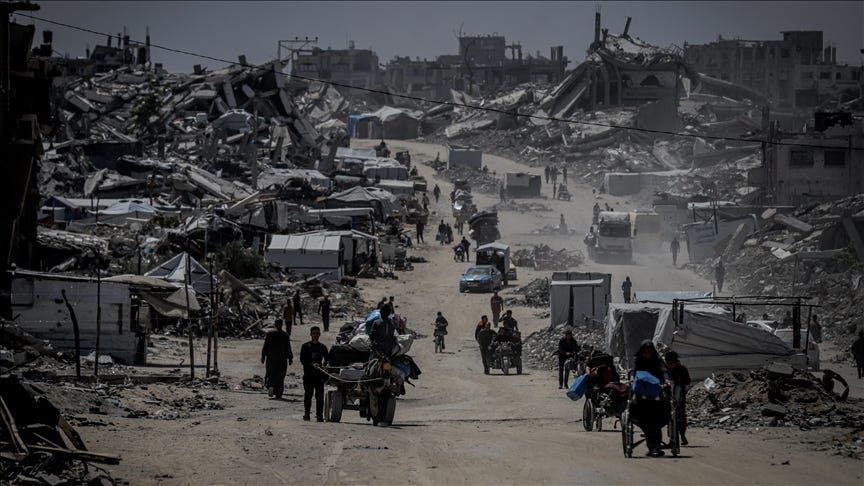
Since then, Israel has gradually escalated its operations: more airstrikes, deeper incursions, and intensified targeting of Hamas infrastructure. These efforts have culminated in the current offensive, which aims to achieve what previous campaigns have failed to accomplish: dismantle Hamas entirely and bring the hostages home.
However, military campaigns of this nature rarely unfold as planned (the famous military saying: “No plan survives contact with the enemy”). Counterinsurgency warfare in densely populated urban areas is notoriously brutal, slow, and unpredictable. The further Israeli forces advance into Gaza, the more they will encounter the grim realities of tunnel warfare, booby traps, and a militant group that has had over a decade to prepare for this very moment. The IDF is attempting to mitigate this threat with massive airstrikes on Hamas positions, but this results in significant collateral deaths and the ensuing international condemnation.
Here lies the real danger. If Israel fails to achieve its objectives swiftly, international pressure will intensify. Civilian casualties will continue to rise, leading to a humanitarian crisis that may become politically untenable even for allies. Europe, already fractured and fragile, may withdraw its diplomatic support. The Arab world, largely passive so far, may be compelled to react more decisively if images of mass suffering dominate global headlines. Even the USA, despite Trump’s support, has its limits.
The nightmare scenario is one in which Israel is compelled to cease operations before dismantling Hamas’s leadership or securing the return of all hostages. In such a scenario, Hamas will emerge not only physically intact but also politically emboldened. The remaining leaders will assert that they survived yet another Israeli offensive, repelled the IDF, and retained power. That narrative, however inaccurate, will resonate across the region and beyond.
Worse still, not all hostages (or their remains) may be recovered. The tunnels beneath Gaza are deep, vast, and controlled by a group that regards martyrdom as victory. In this context, expecting a full accounting of the missing is tragically optimistic.
The costs of failure would be immense: Hamas survives and regains legitimacy, Israeli deterrence is weakened, and the strategic status quo becomes entrenched. Meanwhile, Gaza remains a humanitarian disaster zone, lacking a viable plan for reconstruction or governance. The long-sought objective of a post-Hamas Gaza would once again fade into abstraction.
Operation Gideon’s Chariots is a gamble; one born of frustration, necessity, and strategic ambition, yet it now stands at a crossroads. Either Israel is permitted to complete what it initiated, at the risk of diplomatic rupture and humanitarian catastrophe, or it is compelled to halt, leaving Hamas bloodied but intact, and a region still ensnared in the cycle of war, ceasefire, and inevitable relapse.
The coming weeks will not only test the endurance of Israel’s military campaign but also the resolve of the international community to determine what “peace” in Gaza really means and who gets to define it.
Then let us hope that Israel can achieve her goals as the alternative is untenable in the long run
Thanks for the excellent and sober synopsis. It does seem the situation has reached the denouement. May the Lord go ahead of the IDF as He did with Gideon.