
Ceuta’s phantom invasion
The online right declared the fall of Europe. By nightfall, most of the supposed invaders were already back in Morocco.

Online, events in Ceuta have already become the opening shot in the invasion of Europe: according to populist politicians and the terminally Online Right, tens of thousands pouring through a breached NATO frontier, Russian hands in the shadows, and a human wave supposedly heading straight for the heart of Schengen. The videos looked extraordinary. The story attached to them was largely fantasy.
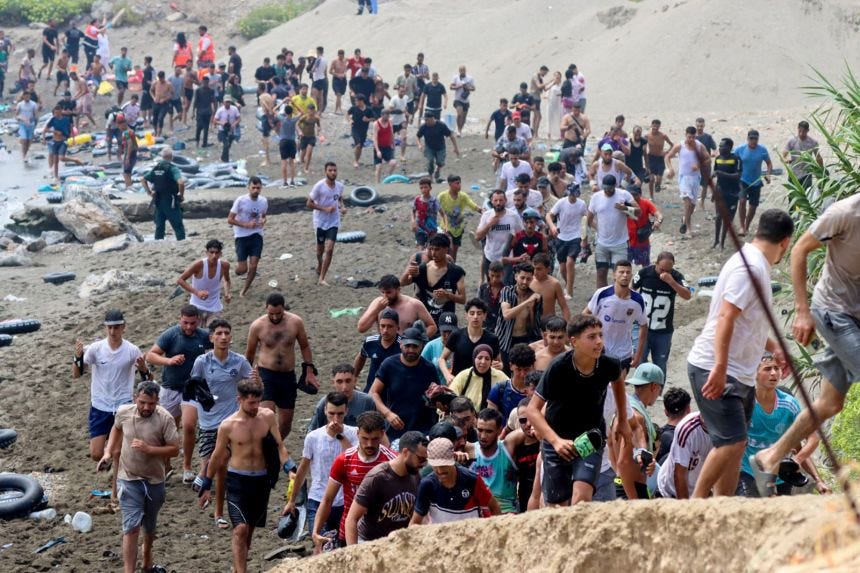
The breach was real and appalling. Spain estimates that roughly 50,000 people crossed from Morocco into Ceuta, while the local government puts the figure nearer 60,000. Fifty-seven people died. Spanish troops were deployed, and Pedro Sánchez called it a violation of Spain’s territorial sovereignty. Spain conspicuously failed to defend its border at the point of entry.
That should have sparked a serious debate about border security, Moroccan leverage and Spanish complacency. Instead, it triggered an orgy of online panic among people unwilling to spend thirty seconds looking at a map.
Ceuta is a Spanish city on the North African coast, surrounded by Morocco and the sea. The only regular routes onward are by ferry or air, and both are controlled. Ceuta is part of the Schengen Area, the European passport-free travel zone, but Spain retains a special regime requiring police identity and document checks. Entry into the enclave places someone on Spanish soil without granting free movement to mainland Spain, France or anywhere else in Europe.
The numbers demolish the hysteria more effectively than the geography. Spain’s Interior Ministry initially said that at least 25,000 people had returned to Morocco. By Friday evening, that estimate had risen to 48,300. Most went back voluntarily after discovering that Ceuta offered no food, shelter, work or a magical passage to the continent. The supposed invasion was reversing while Europe’s populists were still recording their reaction videos.
Spain has legal mechanisms for returning those who remain. A 1992 agreement allows it to request that Morocco readmit people who have been shown to have entered through Moroccan territory. Moroccan nationals can be identified and returned; other entrants can receive individual removal decisions. Asylum claims and unaccompanied children require separate procedures, neither of which creates a right to travel across Europe.
Much of the panic stems from a recent Supreme Court judgment concerning swimmers intercepted at sea. Spain cannot use the special summary rejection power designed for people climbing the fence; swimmers require the ordinary process, including a lawyer, an interpreter and access to asylum. The judgment prohibits instant pushbacks in those circumstances. Deportation after due process remains available, and the ferry gates remain under control.
We have seen this film before. In May 2021, around 8,000 to 10,000 people entered Ceuta after Morocco relaxed controls during a dispute over Spain’s medical treatment of Brahim Ghali, leader of the Polisario Front. The Polisario seeks independence for Western Sahara, which Morocco claims. Rabat was furious, Ceuta was flooded, and Spain sent in the Army. Most entrants were returned within days.
These episodes are best described as coercive migration engineering: Morocco manipulated population movement to punish Spain. The quarrel concerned Western Sahara and the balance of power between Madrid and Rabat.
The present crisis has the same shape. Sánchez visited Algeria, Morocco’s principal rival, on 20 July, ahead of a Spanish parliamentary committee advancing citizenship legislation for Sahrawis and their descendants. That timing proves nothing by itself, but it offers a more plausible context than a continent-wide operation intended to put 60,000 people on the streets of Calais.
A 2024 episode showed how decisive Moroccan enforcement can be. Social media calls drew around 3,000 people to Ceuta, but Rabat deployed heavily, halted the crossings, and arrested 152 alleged instigators. Digital mobilisation can assemble the crowd, but Moroccan policing largely determines whether it becomes a Spanish border crisis.
Ceuta gives Morocco an unusual pressure valve. Rabat controls the roads, towns and police deployments outside a small Spanish enclave. When relations deteriorate, Spain discovers how dependent its border is on the country that contests its sovereignty. Morocco can then restore control and help arrange returns.
That pattern is peculiar to Ceuta and, to a lesser extent, Melilla. It bears little resemblance to 2015, the Balkan route, Mediterranean journeys from Libya to Italy, or small boats across the English Channel. Most were Moroccans crossing directly into a tiny enclave with restricted onward travel. Tens of thousands returned across the same frontier within hours.
Spain’s own figures make the contrast even starker. Before this breach, irregular arrivals across Spain were down almost 25 per cent year on year, while entries into Ceuta had risen sharply. The national trend was falling as this one enclave spiked. That is evidence of a local rupture rather than a fresh continental tide.
Spain’s failure remains stark. A border overwhelmed by a rumour, with weak staffing and shifting Moroccan behaviour, is a serious national security vulnerability. Sánchez should explain why the frontier was so thinly defended and why Spain remains exposed to pressure from Rabat. Those charges require no imaginary march on Berlin.
The terminally online right chose the imaginary march anyway. Every clip must now prove civilisational collapse, while corrections are treated as betrayal. Politicians who knew Ceuta’s geography joined in. Meloni imposed targeted checks on arrivals from Spain, even though those she claimed to fear had no unchecked route from Ceuta and were already returning to Morocco in their tens of thousands.
Russian propagandists will amplify the spectacle because frightened, divided European societies serve Moscow. They need not fabricate the narrative. Western populists and engagement farmers distribute it for free, complete with recycled footage and maps apparently drawn from memory.
The border hawks have copied the activists they despise. They accuse the other side of refusing to discuss migration honestly, then bury the geography and return figures that undermine their own story. Morocco’s coercion, Spain’s negligence and 57 deaths are damning enough. They prefer the lie that Europe has already fallen.
Most of the crowd has now returned to Morocco. The hysteria is still travelling north.
Summer Sale! This weekend is your last chance to get a year’s subscription to Fox On War with 20% off. Gain full access to the archives, deep dive analysis, and reports from the ground (trips to Israel, Ukraine, and possibly Yemen are currently in the mix). For the nuanced, balanced and evidence-based reporting the mainstream media never supplies, just hit the button:
You can now follow me on:
Or visit my homepage at www.andrewfox.online
So Ceuta is not in Europe but on the coast of Morocco. Sounds like Guantanamo bay area in Cuba for the US except this is a city not a prison.
Anyway thanks for the clarification.
I think though it does speak to the unrestrained immigration crisis especially in the UK and that is why so many could harp on what happened, whether it made sense or not.
I also think Meloni was actually making more of a point to Spain and telling Sanchez to get his house in order, not that he will. Besides what I saw from both left and right apparently this mob breaking through like that is all the Jews (ahem I mean zionists) fault anyway. Some new dastardly plan from us nefarious yidden.
Unfettered immigration has created a nightmare in Europe not the least of which is unbridled antisemitism which the authorities seem to do absolutely nothing about, never mind the rise in rapes and gang violence throughout the continent. When you have a society already in flux, and already on edge, it will only take a small spark to light a fire.
Totally agree, and a lot of people thought that Ceuta was actually in Spain and not in Northern Africa. It is quite similar to what happens with Turkey from time to time. With Morocco it’s usually tied to territorial disputes, and with Turkey it’s usually to pressure the EU to keep its financial aid pacts to control migration to European territories.